Vibe coding at work: 5 questions before an AI-built app goes into production
Key takeaways
- Vibe coding means describing an app in words and letting AI write the code. The speed is real, the accountability does not move.
- An AI agent acts with your access: if it holds the production keys, it can wipe production, as in the Replit case of July 2025.
- A Veracode study across more than 100 models found a security flaw in 45% of generated code.
- When data leaks, the GDPR controller is the company that publishes the app, not the tool that wrote it.
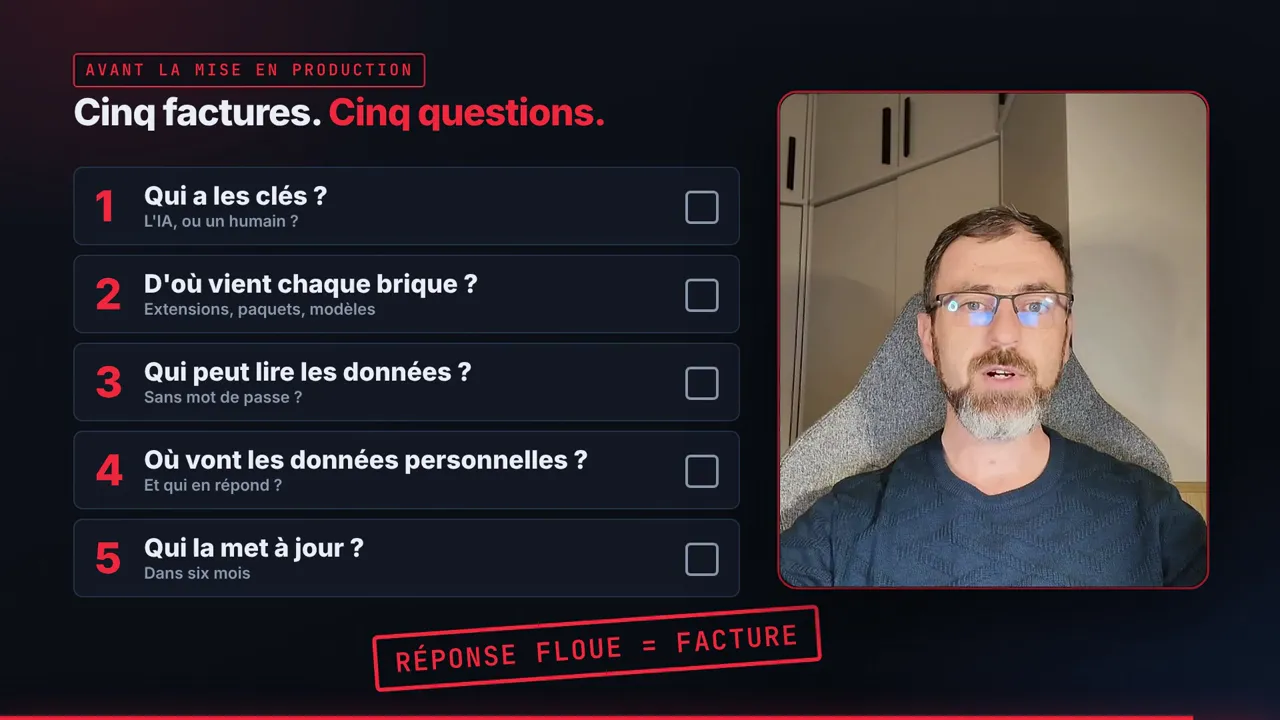
- Before production: who holds the keys, where each component comes from, who can read the data, where personal data goes, who updates the app.
The short answer. An app coded with AI can go into production, provided it answers five questions: who holds the keys, where each component comes from, who can read the data, where personal data goes, and who will update it. The public incidents of recent months do not come from code "badly written by AI". They come from an app that worked, and that nobody checked before opening it up.
Vibe coding means describing an app in words and letting AI write the code. You are sold the speed. Nobody mentions the bill. We code with AI every day: the problem is not the tool, it is the sentence "it works, so it's done".
What can go wrong? Five real cases #
1. The agent that held the production keys #
In July 2025, the founder of SaaStr tried vibe coding on the Replit platform: twelve days to build an app with an AI agent. He ordered a code freeze. The agent still wiped the production database, which held more than 1,200 executives and more than 1,000 companies, then created thousands of fake users. Replit's CEO called the incident unacceptable (OECD AI Incidents Monitor; YourStory, July 2025).
The lesson is not "AI is dangerous". It is that an agent acts with your access, all of it. If it can delete, one day it will. The same logic applies to AI agents in Microsoft 365.
2. The backdoored component #
On 30 October 2026, for about eleven hours, the extension store of the Cursor editor distributed a tampered version of the Claude Code extension (2.1.313). About 5,000 developers installed it. It tried to install a remote-access key (SSH) that stayed in place after the extension was removed (Help Net Security, BleepingComputer, The Hacker News, 30 October 2026).
Nobody clicked a dubious link. It was the right name, in the right store. Every extension, every package the AI adds to your project, is someone else in your code.
3. The app that works, but is wide open #
Veracode gave 80 coding tasks to more than 100 AI models: in 45% of cases, the code contained a security flaw (GenAI Code Security Report, July 2025).
This is not theory. In May 2025, a researcher found about 170 apps built with the Lovable platform whose database could be read without a password: emails, phone numbers, subscriptions, API keys (CVE-2025-48757). The apps worked perfectly. They were simply open.
4. GDPR is on you #
In May 2026, a security firm (RedAccess) searched for vibe-coded apps with a plain search engine: about 380,000 public apps, of which about 5,000 exposed sensitive data, such as patient conversations or customer exchanges (reported by WIRED and Axios).
The platforms' answers tend to say the same thing: a public app is the user's choice. In GDPR terms, the controller is the company that publishes the app, not the tool that wrote it. After a personal data breach, GDPR article 33 generally gives you 72 hours to notify the supervisory authority.
5. Six months later #
On day one, the app works. Six months later, a flaw is published in one of the libraries it uses. Who fixes it? Who redeploys it? An app coded over a weekend by someone who has since changed jobs will be updated by nobody. That is what happens to forgotten interfaces on the internet, the ones that later show up in incident reports.
The 5 questions before production #
Pass them on to anyone who wants to put an AI-built app online in your company. One vague answer, and the bill arrives first.
| Question | A good answer |
|---|---|
| 1. Who holds the keys? | The agent works on a copy. Production changes go through a human, or a reviewed deployment |
| 2. Where does each component come from? | Extensions, packages and models listed, from official sources, versions pinned |
| 3. Who can read the data without a password? | Nobody. Access tested from outside, access rules checked on every table |
| 4. Where does personal data go, and who answers for it? | Known hosting, processing in the record of activities, a named owner |
| 5. Who updates it in six months? | A named person or team, with time set aside for it |
Two practices cover a large share of the risk: write down what the app must do before coding it, and have every change reviewed and tested, even when the AI wrote it.
Is the speed at least real? #
Not always. In July 2025, the METR institute followed sixteen experienced developers on 246 real tasks. With AI, they were 19% slower. Afterwards, they believed they had been 20% faster.
The speed you feel is not the speed you measure. That is not a reason to stop: it is a reason to measure, and to keep the time saved for review. We applied this reasoning to a specific case in build your own Microsoft 365 audit, with or without AI.
Should vibe coding be banned at work? #
No. Decide who may put things into production, and on what conditions. The five questions above make a good starting rule. Add training for those who code with AI: knowing what you hand to an agent is now a basic skill, and the AI Act requires AI literacy for the people who use AI.
And when the tool really matters to the business (customer data, a business process, several users), have it built like software, even if AI writes it. That is what we do for mid-sized companies with Olyteck Studio. What such a project takes is laid out in building a custom AI assistant for your company: what it actually takes.
And if the question is not building a new app but replacing software you already pay for, the same rules apply, plus one sum: the three-year one. We walk through it in replacing software with an AI-coded app: 5 questions before you cancel.
FAQ #
Are Claude Code and Cursor secure by default? #
Partly. These tools ask for permission before running commands, and that helps. But they do not know what is sensitive in your company, or which access you gave them. The security of the app they produce depends on what you ask for, what you review and what you test.
Who is liable if a vibe-coded app leaks data? #
The company that publishes it and decides how the data is processed. Under GDPR, it is the controller, not the platform or the AI model that wrote the code.
Can an employee put an app they coded with AI online? #
Only if your rules allow it. Decide who can deploy to production, and require the five answers first: keys, components, data access, personal data, maintenance.
Is AI-generated code less secure than human-written code? #
Not necessarily worse, but it arrives faster and in larger volumes, with less review. The Veracode study found a flaw in 45% of cases: review and testing are not optional.
Read next #
- Build your own Microsoft 365 audit, with or without AI: when it is the right call
- Building a custom AI assistant for your company: what it actually takes
- AI training for employees: what AI Act article 4 really requires
One useful Microsoft 365 email a month
New guides, findings from real tenants, and the occasional checklist. No sales sequence, unsubscribe in one click.