REA, the AI that copies any software: should you replace yours? 5 questions before you cancel
Key takeaways
- REA (Reverse Engineer Anything) plugs an AI agent into reverse-engineering tools; a video player was rebuilt in about fifteen minutes.
- Copying existing software is the wrong target: French law forbids decompiling to rebuild a substantially similar program. Building your own tool for your own need is allowed.
- Do the maths over three years: build, run, maintain, and the day it breaks.
- An agent acts with the access of whoever launches it, and under GDPR the company that publishes the app is the controller.
- Before you cancel: what does it cost over three years, who sees the data, who owns it in year two, who approves production, is it regulated or connected to the outside.
The short answer. REA shows that AI can rebuild a good part of existing software in minutes. But for a company the real question is not "can we copy it?", it is "should we stop paying?". Before you cancel a subscription for an app coded with AI, do three sums (cost over three years, risk, organisation) and answer five questions. Five clear answers: you can stop paying. One vague answer: you will pay twice.
A journalist asked an AI to copy a well-known video player. Fifteen minutes later he had his own: playlists, equaliser, keyboard shortcuts, without a single line of the original code (Notebookcheck, 25 October 2026). The tool is called REA. And according to McKinsey, one company in three has already dropped the purchase of at least one piece of software because AI could build it (The state of AI, August 2026, 1,719 respondents).
What is REA? #
REA stands for "Reverse Engineer Anything". It is an open-source project that plugs an AI agent, such as Claude Code, into reverse-engineering tools. The agent reads a program, works out what it does, and writes a new version. The project passed 300,000 GitHub stars in three weeks (Pix Geeks, 23 October 2026). A game was rebuilt in 12 minutes 29 seconds (IT-Connect, 29 October 2026).
Two caveats the demos rarely show. REA returns pseudo-code, not source code, and the project itself lists several hundred limitations. And a fake "REA" repository offering a ready-made Windows build circulated in October and was reported as trapped (Pix Geeks). The only safe starting point is the project's official page, as with the free Adobe clones.
Copy or replace: what the law says #
Copying software is what REA promises. It is also the slippery part. Under the French Intellectual Property Code (article L122-6-1, which transposes the EU software directive), you may observe and test software, and decompile it for interoperability, but not to rebuild a substantially similar program. The REA project says so itself: it is not meant for proprietary software.
Replacing is different. A feature, an idea, is not protected: the Court of Justice of the EU said so in SAS Institute (2 May 2012). Building your own tool, for your need, with your data and your rules, is allowed. And it is often simpler than copying.
So forget the photocopier. The real question is whether it is worth it.
The story: "I'll rebuild it in two days" #
Take a company of 150 people. It pays for an internal request-management tool, say €24,000 a year. A developer looks at it and says: "I'll rebuild it with AI. In two days." And he is right: in two days, it works. The boss sees €24,000 saved per year and signs the cancellation.
Six months later the story has two possible endings. Between them sit three sums almost nobody does before signing.
Sum 1: what it really costs #
Everybody sees the two days. Nobody sees the rest: hosting, the calls to the AI model if the app makes any (about one company in five already limits its AI use because of that cost, according to McKinsey), and above all keeping it alive. A request from a department, a bug, a security update. Say one day a month of someone's time: two weeks a year.
Do the maths over three years: the subscription, against build, run, maintain, and the day it breaks. Beware of felt speed too: experienced developers who believed they were 20% faster with AI were, when measured, 19% slower (METR, July 2025).
Sum 2: what you risk #
Three questions, no more.
- Who sees the data? The tool runs at your place, but what it sends to the AI model goes to a provider, with its own policy. Under GDPR article 28, that provider is a processor.
- What rights does the building agent have? An agent acts with the access of whoever launches it, all of it. Treat it like an intern: delegate, never hand over the keys, and review. We covered this in 5 questions before an AI-coded app goes to production.
- Who fixes the flaw? In Veracode's study of more than 100 models, 45% of generated code contained a security flaw (July 2025). With the vendor, it was their problem. With your app, the GDPR controller is you, usually with 72 hours to notify a breach (article 33).
Sum 3: the organisation #
AI did not change responsibility. It just made it invisible, because it goes fast. Three things to write down before the first line of code:
- An owner. Not the enthusiastic developer: someone who answers for it in year two.
- A production rule. Who reviews, who tests, who says yes. The agent never touches production alone.
- A one-page plan. Where it runs, what data goes in, what it connects to.
And accept that version one will be imperfect, as long as an update date exists.
Six months later: the two endings #
Ending A. The developer has left. Nobody took the app over. An internal rule changes, the app does not follow, requests go back to email. After eight months the company buys the subscription back, at a higher price, because it lost its old rate.
Ending B. Same company, same developer, same two days. But there is a name next to the app, one day a month budgeted, and one page that says how it works. It still runs, a second app has plugged in next to it, and the saving is real.
The difference is neither the AI nor the developer. It is what was written down before cancelling.
Build or buy: how to sort #
| Build when... | Buy when... |
|---|---|
| The tool is unique to your business and nobody sells it the way you need | It is regulated: payroll, accounting, invoicing. You pay someone to follow the law for you |
| The blast radius is small: a week of errors costs neither money nor data | It is connected to the outside: customers, banks, suppliers |
| Someone at your place can own it, not just launch it | The answer to "who owns it?" is silence |
Build what makes you different. Buy what keeps you compliant. The same reasoning applies to a more technical case in building your own Microsoft 365 audit with AI.
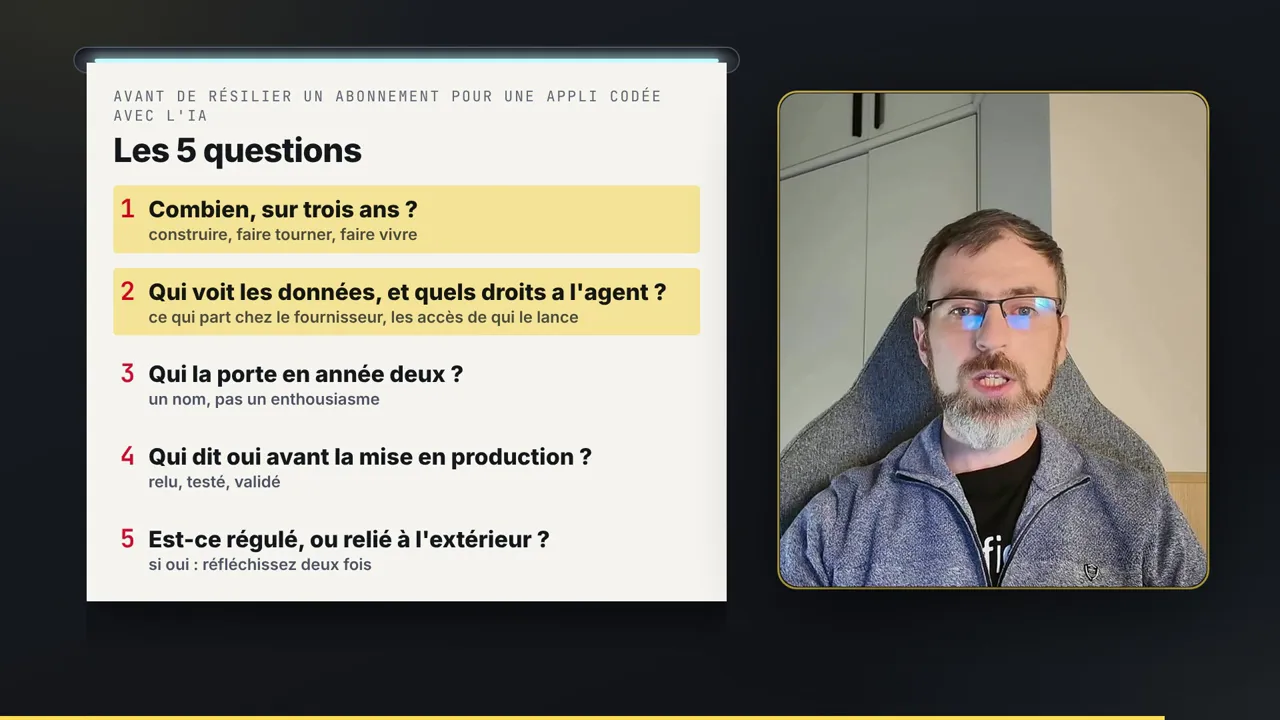
The 5 questions before you cancel #
Pass them to your team before the next cancellation.
| Question | A good answer |
|---|---|
| 1. What does it cost over three years? | Build, run, maintain and repair, costed next to the subscription |
| 2. Who sees the data, and what rights does the building agent have? | Known model provider, sensitive data excluded, agent working on a copy |
| 3. Who owns it in year two? | A named person, with time set aside |
| 4. Who says yes before production? | A review and tests, by someone other than the author |
| 5. Is it regulated or connected to the outside? | If yes, think twice: buy, or have it built as real software |
Five clear answers: you can stop paying. One vague answer: you will pay twice.
At Olyteck we replace software, or pieces of software, with AI, for ourselves and for companies. But we cost the gain before writing a line, and when the numbers do not hold over three years, we say no and explain why. That is the job of Olyteck Studio.
FAQ #
Is REA legal? #
The tool itself is an open-source project. The question is how it is used: in France, decompiling proprietary software to rebuild a substantially similar program is forbidden (article L122-6-1 of the Intellectual Property Code). Replacing a feature with your own tool is allowed.
Can you replace a SaaS with an app coded with AI? #
Yes, when the tool is specific to your business, the blast radius is small and someone can own it. Do the sums over three years, not over the two days of development.
What goes to the AI model provider? #
Whatever the agent sends it to work: the code, files and data it reads. Check the provider's policy, and give the agent access only to what it needs.
Who is responsible if the app leaks data? #
The company that publishes it. Under GDPR it is the controller, not the tool or the model that wrote the code.
This is not legal advice. The SME story is an example.
Read next #
- Vibe coding at work: 5 questions before an AI-built app goes into production
- Build your own Microsoft 365 audit, with or without AI: when it is the right call
- Building a custom AI assistant for your company: what it actually takes
One useful Microsoft 365 email a month
New guides, findings from real tenants, and the occasional checklist. No sales sequence, unsubscribe in one click.